
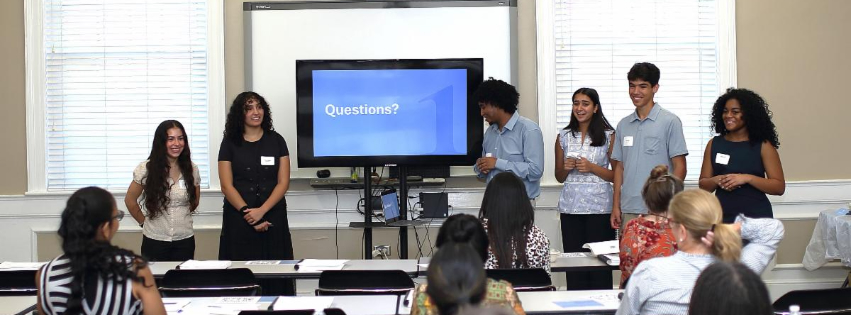
At The Echo Foundation’s annual Faculty Workshop in Charlotte this year, the experts at the front of the room were not professors or authors. They were students.
Echo’s student interns unveiled the foundation’s 2026 curriculum, “The Arts as Witness,” a teaching resource developed entirely by students that explores how creative expression bears witness to the human experience — inspiring understanding, challenging perspectives and connecting people across language, time and culture.
Behind the curriculum is a collective 1,300 hours of student research, creativity and collaboration, according to the foundation. At the workshop, the interns presented the ideas, creative decisions and key insights that shaped their work, then led discussion questions that had students and educators examining together how art can bear witness to shared humanity and turn empathy into action.
Two Charlotte educators, Lynne Coyne and Julie McConnell, shared how they use Echo curricula in their own classrooms. Each Echo curriculum is aligned with the North Carolina Standard Course of Study so teachers can readily reference and apply its topics in their courses, and all Echo curricula are available online free of charge.
The workshop also heard from two of Echo’s Footsteps Ambassadors, students who reflected on a recent journey through Europe, where they visited humanitarian landmarks and took part in a Youth Peace Summit that brought together young people from more than 60 nations. The Footsteps Global Initiative competitively selects regional high school students for a year of intensive study, service and travel to places of humanitarian significance — past journeys have taken students to Europe in the footsteps of Elie Wiesel and to Rwanda to work with Partners In Health.
Student authorship is a hallmark of the Charlotte-based foundation. Its 2018 curriculum, “Charlotte: A Tale of Two Cities,” likewise grew out of student work, that time examining the city’s opportunity divide.
The Echo Foundation grew out of a challenge. On March 12, 1997, Nobel Peace laureate Elie Wiesel spoke “Against Indifference” to more than 23,000 Charlotte students and adults; as he left, he urged the community to act on its convictions, telling founder Stephanie Ansaldo, “You can’t stop now, you must do more, and I will help you!” In the years since, the foundation says it has brought 19 Nobel laureates and 53 global humanitarians to Charlotte and has educated hundreds of thousands of students by equipping teachers with curricula on global humanitarian issues.
More information on “The Arts as Witness” is available at echofoundation.org.